top of page
DSCN7287.JPG

Discover the Joy

" The most important period of life is not the age of university studies but the first one, the period of birth to age six. For that is the time when man's intelligence itself, his greatest implement is being formed. "
- Dr. Maria Montessori

Let them learn, lead, and grow together.

In a mixed-age Montessori classroom, younger children learn by observing older peers, while older children deepen their understanding through leadership, collaboration, and example.

Help them develop independence.

Montessori helps children build confidence and responsibility as they learn to make choices, solve problems, and accomplish tasks independently.

Let them explore freely.

Montessori gives children the freedom to follow their curiosity, explore hands-on materials, and make meaningful choices within a thoughtfully prepared environment.

Give your child individual attention.

Montessori allows each child to learn at their own pace, with teachers offering personalized guidance based on their individual needs, interests, and development.

Why Choose Montessori?

“Our care of the child should be governed, not by the desire to make him learn things, but by the endeavor always to keep burning within him that light which is called intelligence.”

- The Absorbent Mind by Dr. Maria Montessori 

Why Choose MSUH?

Montessori girl sweeping floor with broom

We offer an authentic Montessori experience.

Our Head of School is Montessori credentialed and has personally trained all assistant guides in Montessori principles - all of whom have been with the school for 10+ years.

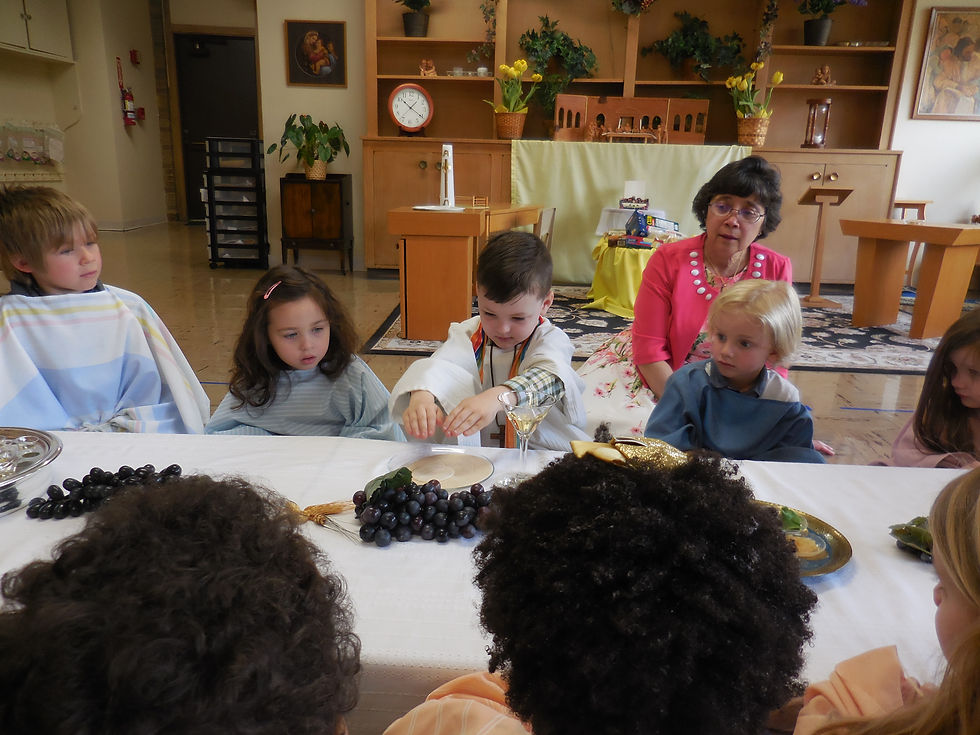
Girl studying Catechesis of the Good Shepherd with carved replicas

We serve the whole child.

In addition to having opportunities to grow physically, emotionally, socially, and intellectually,
children have the opportunity to develop a loving relationship with God though the experiences
presented in the Catechesis of the Good Shepherd.

Montessori aide helping student with their work

Our guides were once in your shoes.

Most of our Montessori guides first knew MSUH as students, parents, or grandparents. Today, they bring that same trust, experience, and sense of community into the classroom.
Maria Wood, Head of School, guiding children through a program

We have been serving children and their
families since 1968.

With roots dating back nearly 60 years, the Montessori School of University Heights is part of a longstanding Montessori tradition in Greater Cleveland.

What ages can my child attend?

Children Enroll at 3 Yrs Old

Applications are accepted year-round for children who will be 3 yrs old by the fall semester.​ 

Space is limited to 10-12 newly entering 3-year-olds.

Children enroll at age three and remain for three years. After completing their third year, children may move to a Montessori lower elementary program or traditional first grade. 
This multi-age dynamic provides many benefits to the young child during the time of the absorbent mind.

DSCN7084.JPG
IMG_1826.jpeg

What's the schedule?

Weekdays 9:00am - 12:15pm

From Labor Day to Memorial Day, all children attend 3.25 hours daily.

Tues/Thurs 12:15pm - 2:30pm

On Tuesdays & Thursdays, 3rd year children attend an additional 2.25 hours to prepare them for the transition to grade school.

Quick Overview

How much will it cost?

$5,500 Yearly Tuition

Tuition is payable in two semesters (Fall & Spring) and is due before the semester begins.

This does not include the $100 registration and $35 application fee.

All tuition transactions are paid through the parent Brightwheel portal.

If you have additional questions, please reach out to the Head of School.

DSCN8601.JPG

Our Programs

Art

logo-colorful-transparent.png
​Art has many facets and components but above all art is a means of self-expression.   "Through creative art work, more than any other work, children develop self-awareness.  They do this by exploring materials and by extending their personalities throughout the materials into visual and concrete products . . . Even their scribbles are extensions of themselves." (Barnett, Let the Sunshine Out) Dr. Montessori believed the way to help children express themselves in drawing and representative art was to provide them with opportunities to develop the use of their hands.  Once the child's hand is trained to be at the disposal of the mind then freedom of expression in art follows.   Children in our program explore a variety of art materials including free drawing, working with clay, pin-punching, painting, cutting and pasting, and collage work.  Children may choose these activities in keeping with their interests and abilities.  Our art instructor plans art activities to introduce children to new mediums.The children become acquainted with various famous artists and their paintings.  The children's art experiences culminate in the creation of scenery and puppets for a play during their third year.
logo-colorful-transparent.png

Catechesis

logo-colorful-transparent.png
The young child is in a sensitive period for developing relationships, first with parents and continuing to other family members, neighbors, and friends.  The young child is also in a sensitive period for developing a relationship with God. It is during the period from birth to age six when the child most easily establishes a loving relationship with God.  When the child, who has a great capacity for love, meets God, who is love, the child experiences unconditional love, peace, and great joy.   Our school utilizes the Catechesis of the Good Shepherd program to meet the spiritual needs of the young child who asks, "Help me come closer to God, by myself." (Cavalletti, Religious Potential of the Child)  Developed by Dr. Sofia Cavalletti in Rome beginning in the 1950's, the Catechesis of the Good Shepherd program contains concrete materials to help the child develop a loving relationship with God through Christ, the Good Shepherd.  The children receive presentations on the catechesis materials approximately once per week in a small group or individual format.  Each child is then free to work with the materials just as they would in the other areas of the environment.  Group celebrations at Thanksgiving, Christmas, and Easter celebrate God's love expressed through time and history and present for us today.
logo-colorful-transparent.png

Geography

logo-colorful-transparent.png
Young children are intensely interested in the world in which they live. The geography materials assist the children in discovering and understanding the characteristics and global nature of the world as well as the variety of cultures and peoples with whom they share the planet. Dr. Montessori considered herself a "citizen of the world" and embraced all cultures and peoples.  She originally developed the geography materials for the elementary school age children to use.  Since the primary environments and elementary environments were separated only by low walls of shelving, the younger children could see the elementary children working with these materials were attracted to them.  Consequently, led by the interest of the young children, Dr. Montessori included these materials in the environments designed for three to six year old children. The geography materials build on the children's sensorial experiences of shape and color.  The materials make concrete the abstract ideas of continents and countries.  Children become acquainted with the shapes of continents, countries, states, and provinces. They enjoy relating various flags to the country each represents.  They explore topographical forms including lake, island, archipelago, cape, bay, peninsula, gulf, isthmus, straight, mountain, and river.  They learn about various cultures through objects collected from countries around the world.  They sing and learn a few words in various languages.  Our multi-cultural community of parents provide a rich resource, as they share their heritage with the children in a group presentation format.
logo-colorful-transparent.png

Language

logo-colorful-transparent.png
The area of language development provides one of the clearest examples of the workings of the child's absorbent mind and the sensitive periods.  At birth the child has no spoken language, yet before the age of three children are able to speak perfectly their native language.  The young child not only has an extensive vocabulary but also has absorbed and uses correctly most of the rules of grammar and syntax peculiar to that language. The sensitive period for the development and refinement of language lasts from birth through age six.  Our language arts curriculum includes activities and materials to enrich and expand the child's language development.  The child's oral language expands through songs, stories, rhymes, finger plays, the reading of books, and oral grammar games.  The adults are conscientious in using accurate vocabulary, modeling proper articulation, and expanding on the child's language. The skills classified as "reading readiness skills" including visual discrimination, visual closure, figure/ground discrimination auditory discrimination, auditory memory, spatial awareness, vocabulary development, gross and fine motor development, classification and sequencing abilities, are developed with the practical life activities and the sensorial materials and expanded upon through the early language materials. Dr. Montessori discovered that the indirect preparation provided by the practical life and sensorial exercises led the children to a point of natural readiness and capability for the direct learning of writing and reading.  The language materials assist the children developing the ability to read and write.  Upon completion of our program, most children read at or above grade level.  They are confident in their reading skills and joyfully read and write spontaneously.
logo-colorful-transparent.png

Math

logo-colorful-transparent.png
The young child’s sensitivity to order is intimately linked to what Dr. Montessori referred to as the “mathematical mind,” a term she borrowed from the French philosopher Pascal.  This term does not relate specifically to the ability to understand mathematics but rather to the tendency of the human mind toward exactness. Montessori reasoned that since the child is endowed with a “mathematical mind” and since mathematics is a precise science that the learning of mathematics should be a joy “. . . if only its roots can be implanted in the absorbent mind.” (Montessori, The Absorbent Mind)  The period of the absorbent mind, from birth to age six, is the time when mathematical concepts can be most easily absorbed from experiences with concrete and precise math materials. The children are prepared indirectly for grasping mathematical concepts through the exercises of practical life, which develop skills in sequencing and ordering, and through the sensorial materials.  The order, clarity, and precision of the sensorial materials satisfies and further develops the child’s mathematical mind, preparing it for higher intellectual activities.  The base ten system is inherent in many of the sensorial materials.  Children who have had repeated and varied experiences with the sensorial materials “possess all the instinctive knowledge necessary as preparation for clear ideas on numeration.” (Montessori, Dr. Montessori’s Own Handbook) Since the process of internalizing mathematical concepts must begin with concrete experiences, the math materials are concrete representations of abstract concepts. Child in our program joyfully explore numeration to one thousand, the base ten system of units, tens, hundreds, and thousands, addition, subtraction, multiplication, division, squares and cubes of the numerals from one to ten, fractions, time, money, and geometry.  For Montessori children, the learning of mathematics is a delight.  Many adults upon seeing the math materials exclaim, “I wish I had these to work with when I was young!”
logo-colorful-transparent.png

Music

logo-colorful-transparent.png
Music is a natural "language" for the young child. Young children sing spontaneously and absorb music and songs they hear.  They move to music as they explore and respond to rhythms and melodies.  The young child's attraction to music begins in the womb and continues through the sensitive periods and time of the absorbent mind. Children in our environment enjoy a variety of musical experiences including singing, playing music with instruments and the Montessori bell material, listening to a variety of musical styles, enjoying guest performances by alumni, parents and children in the class, moving to music, clapping out rhythms and exploring the various components of music such as pitch and tempo.  The children's musical experiences culminate in composing an original song to accompany the play they perform for their peers and parents during their third year.
logo-colorful-transparent.png

Practical Life

logo-colorful-transparent.png
Traditional educational theory and practice tends to isolate the development of the body as separate from and inferior to the development of the intellect. Dr. Montessori identified the close relationship between movement and the development of the intellect. An infant relies totally on random movement at birth. At some point in that random movement the infant grasps an object. Eventually the grasping becomes intentional. A random movement becomes the spark that awakens in the infant an awareness of her power and movement then comes under the direction of the child’s mind and will. “Movement helps the development of the mind, and this finds renewed expression in further movement and activity. If follows that we are dealing with a cycle, because mind and movement are parts of the same entity . . . Now the muscles directed by the brain are called voluntary muscles, meaning they are under the control of the will, and willpower is one of the highest expressions of the mind.” (Montessori, The Absorbent Mind, p. 146) The primary purpose of the Practical Life exercises is to assist the child in developing refinement of movement and coordination of bodily movements among the parts of the body and to put the child’s movements under the direction of the mind.  The young child, 2 1/2 to 6 years of age, has an intense interest in exercising the use of his/her voluntary muscles. During this sensitive period it is imperative that the child be given opportunities to develop coordination of his movements. “Since he must develop himself through his movements, through the work of his hands, he has need of objects with which he can work that provide motivation for his activity.” (Montessori, The Secret of Childhood, p.82)
logo-colorful-transparent.png

Science

logo-colorful-transparent.png
The young child is born into a world of wonder.  Everything in nature amazes the child and the child hungers for knowledge of the world and its creatures.  The science materials satisfy the child's desire to understand, name, classify, and order impressions from the natural world. Our children explore the names and classifications of animals as they work with the animal anatomy puzzles, the nomenclature cards and the classification cards. They become acquainted with flowers, plants, and trees as they work with the nomenclature cards, parts of the plant puzzles, and the botany cabinet.  As they become readers they enjoy reading and copying information from books about animals.  They are encouraged to conduct experiments to discover scientific principles.  They enjoy making collections and examining items found in nature.   Our wall of windows allows the children to observe nature continually through the day.  Experiences in planting, animal care, observing life cycles, and recycling nurture the child's love and respect for the world in which we live.
logo-colorful-transparent.png

Sensorial

logo-colorful-transparent.png
The construction of the child's intellect and personality takes place as the child relates to the environment.  The environment provides both the stimulus and the material with which the child will develop intellect, will, and personality.  There is a constant exchange between the child and the environment in which the child chooses to attend to certain stimuli, based on the inner drives of the sensitive periods.  The efforts the child makes in adapting to the environment accomplish the child's self-construction. "The child has a different relation to his environment from ours.  Adults admire . . . remember . . . and think about it; but the child absorbs it.  The things he sees are not just remembered; they form a part of his soul." (Montessori, The Absorbent Mind) It is through the senses that the child both experiences the world and relates to it.  The world is full of sensorial impressions.  The work of the child in developing the intellect involves the ability to distinguish the differences and similarities in the objects of the environment, classify, organize, and grade the characteristics of these objects and to formulate abstract ideas front them.   "There is nothing in the intellect which was not first in the senses."  (Aristotle) Dr. Montessori believed that the development of the senses precluded higher levels of intellectual activity.  The senses must be refined, trained, and perfected so that they will perceive information accurately and be skilled in careful observation.  The benefits of well-trained senses is not limited to the development of the intellect and the practical aspects of life as they relate to being of service to the individual in occupations and hobbies but extend to being able to appreciate and enjoy beauty in the world. "The beautiful harmonies of nature and art escape those whose senses are dull." (Montessori, The Discovery of the Child) From the age of two and one-half to six the child not only seeks out sensory experiences but also seeks to refine and perfect the use of the senses.  The sensorial materials help bring to order the sensory experiences of the child and assist in deriving abstractions from them.  The materials provide the child with specific experiences that help the child to classify and order mental images.  Each material isolates one concept such as color, length, weight, size, shape, texture, or volume through a series of gradations, contrasts, or identities.  The objects in an activity are identical among themselves with the except of the one essential and variable quality
logo-colorful-transparent.png

Parent Testimonials

5 star award

A superior Montessori experience!

"Maria and her dedicated staff provide a superior Montessori experience for young children. The school offers a peaceful and caring environment while encouraging the whole child. Your child will leave this school prepared and confident, with a lifetime love of learning."

Kimberly Dyer
5 star award

5 stars is not enough!

"My children were in classes with children of a variety of ethnic, religious, and racial backgrounds. NEVER, ever did I witness anything that was contrary to the desire to see each child in the unique image of God... My children are lifelong learners who clearly still exhibit the best Montessori has to offer. 5 stars is not enough for the wonderful experience my children were blessed to receive."

Melody McMahon
5 star award

Quality teachers, great community!

"My children thrived in this environment. I cannot say enough about the quality of education and how amazing the teachers were with the students. Also, all of the families were very welcoming which created a great community. Both of my children were extremely well prepared for grade school thanks to MSUH."

Jacob Zuzic
bottom of page